Blue-footed boobies
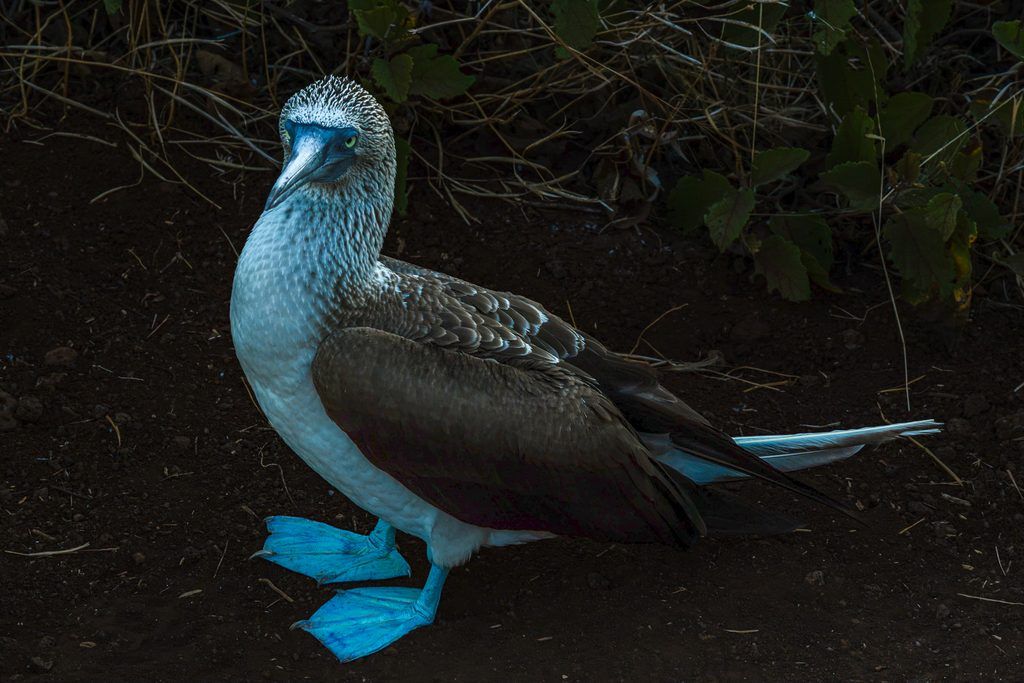
The funny name almost matches these creatures’ funny look. Blue-footed boobies are most easily recognized by their signature feet. The birds’ mating ritual is also an entertaining affair, as males lift their feet up and down in a strutting display for the females.
You can spot them on Galapagos excursions in the National park accompanied by Galapagos islands travel guide. Ask us for Galapagos islands accommodation during your trip.
Description of blue-footed boobies
The blue-footed booby is 80 cm long. Females are usually larger and heavier than males. The weight of the birds is approximately 1.5 kg. The legs of the birds have bright blue swimming membranes – a hallmark of this species. The tail and wings are usually long and pointed. The plumage is brown-white, the beak is gray-green. Females around the pupils have a dark pigment ring, which visually enlarges their eyes. In nesting places, their behavior towards people is bold.
Spread & Lifestyle
Blue-footed booby nests mainly on the Galapagos Islands, as well as on the arid islands of the Gulf of California, on the west coast of Mexico, on islands near Ecuador and northern Peru. Of the 40,000 pairs of these birds, approximately half live in the Galapagos Islands, where blue-footed boobies are protected by law.
Reproduction
The blue legs of the males play a significant role during the current period. Females prefer a male with blue-colored legs and neglect a male whose legs look gray-blue.
Birds nest in colonies on the islands of Central and South America. Their nesting sites are located at a relatively far distance from each other. The nesting period lasts all year, with the female laying at every 8 months. Usually, the female lays 2 or 3 white eggs for one week, and both parents hatch her 40 days. Chicks leave the nest after 102 days. At 3-4 years they become sexually mature.
Population decline
Concerns of a decline in the booby population of the Galápagos Islands prompted a research project in its cause. The project, completed in April 2014, confirmed the population decline. The blue-footed booby population appears to be having trouble breeding, thus is slowly declining. The decline is feared to be long-term, but annual data collection is needed for a firm conclusion that this is not a normal fluctuation.
Best places to see Blue-footed Boobies
North Seymour and Punta Suárez are the two places I would put at the top of an itinerary focused on blue-footed boobies. North Seymour has large populations and open nesting areas, while Punta Suárez is particularly good because the boobies nest right along the visitor trail.
Punta Pitt is especially interesting if you want to see several booby species in one place. The site has breeding colonies of blue-footed, Nazca and red-footed boobies.
Blue-footed boobies can be observed at several visitor sites throughout the Galápagos, including North Seymour, Punta Suárez on Española, Punta Pitt on San Cristóbal, and Los Túneles on Isabela. North Seymour and Punta Suárez are among the most notable locations for observing these iconic birds, often at close range along designated visitor trails.
One current note: the Galápagos National Park has recently been monitoring bird populations because of avian influenza, including at several sites with boobies. Recent monitoring reported healthy blue-footed booby populations at the western sites examined, but conditions can change, so visitor access and wildlife observations should follow current Park guidance.
Come to spend your Galapagos islands family vacation! We’ll help you with getting to Galapagos islands.