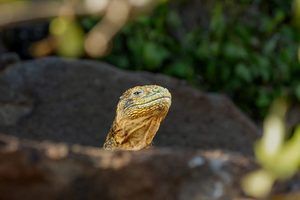
One of the most common and unique animals found on the Galapagos are the islands’ small lizards, often affectionately referred to as “lava lizards.” There are at least seven recognized species, each with unique traits. Like with the Galapagos’ finches, the variety of species of lava lizards represent a remarkable example of adaptive radiation.
You can spot them during your Galapagos cruise holidays. We’ll be happy to organize your Galapagos adventure.
Description
Adult Galápagos lava lizards range from around 50 to 100 mm long SVL (snout-to-vent length; excluding tail which can be equal or longer to SVL), with average and maximum sizes varying between islands. Males are on average larger than females, being twice to three times as heavy, with average body sizes of 77 to 91 mm SVL, compared to 63–71 mm of females. In addition to size, there are significant color and morphological differences between sexes, although color varies across islands.
Males are blue gray to brownish, spotted black to ash gray, and tend to have dark crossbands on the neck and anterior portion of the back. The throat has a large black blotch, extending to the base of the forelimbs. Males have a crest of spined scales running down the length of the body, which are longer than those of females. Males also have proportionally longer hind legs.
Reproduction
Prior to mating, males seize the skin of the necks or backs of females in their jaws, and sometimes carry them short distances before mating. Females lay clutches of 1 to 6 white, leathery, elliptical eggs, with larger clutches generally occurring in larger females. On Santa Cruz Island, 2 eggs is most common. Females have been observed digging short burrows to lay eggs in May and June.
Places in the Galápagos where you can see them
- Española – Punta Suárez — probably one of the best places. The trail passes a beach where large Española lava lizards are commonly seen.
- Santa Fé — very good chance of seeing them along the visitor trail, often around the same areas as the endemic Santa Fe land iguanas.
- Santiago — excellent habitat for the endemic Santiago lava lizard, particularly around rocky, dry volcanic terrain.
- Santa Cruz — lava lizards are widespread and can be encountered at many lowland visitor sites.
- Isabela / Fernandina — also good areas, particularly in the western islands.
- Floreana — home to the endemic Floreana lava lizard.
- North Seymour / Baltra / South Plaza — also good possibilities.
In general, you can see these unique animals on almost every major island except Genovesa, Darwin and Wolf.
Go on your Galapagos family cruise! We’ll help you to choose one of the best Galapagos yacht.
Recommended tour for Lava lizards