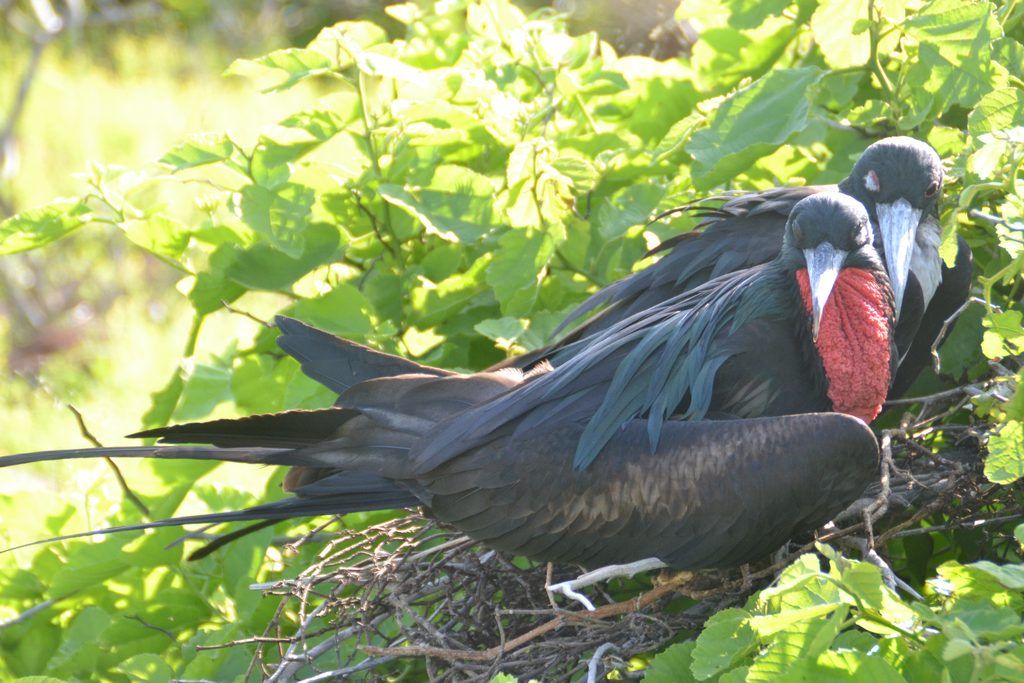
There are few birds easier to recognize than male magnificent frigatebirds. They have a giant red throat pouch which makes for a bright, stunning display when fully inflated. It’s almost comical to see them puff up. Of course, the brighter the pouch, the more attractive they appear to females.
You can spot them during your 4 day Galapagos cruise. We’ll be happy to help you choose from Galapagos ships.
Description
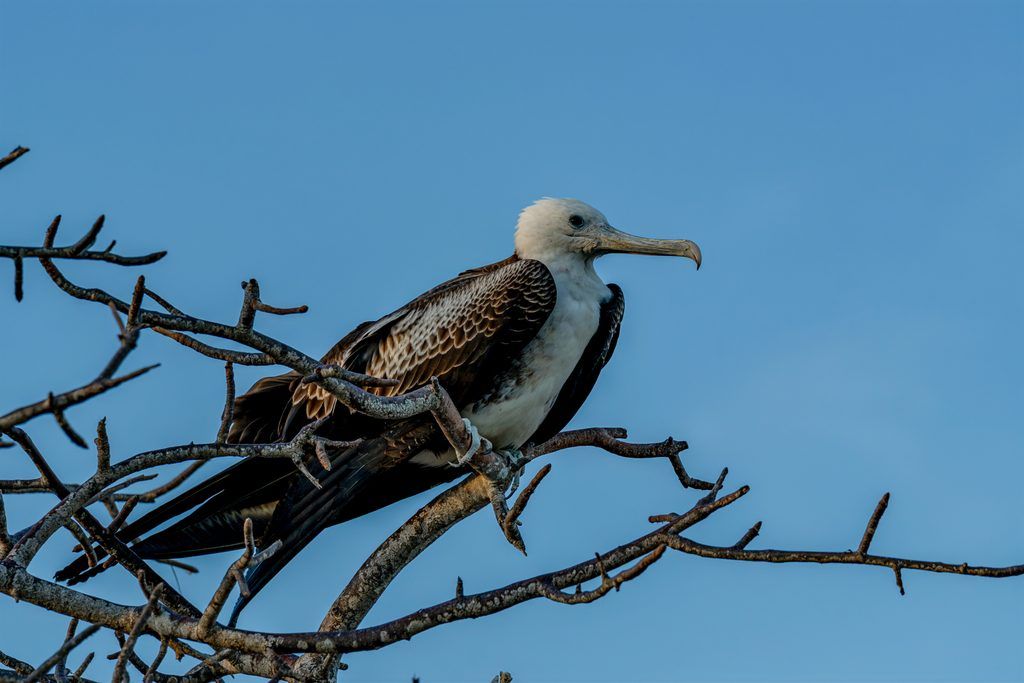
The magnificent frigate is a rather large bird, its size can reach 102 cm, and its wingspan is from 217 to 229 cm. It weighs from 1.1 to 1.6 kg. This species has a long and forked tail. Narrow and long wings form the letter W in flight. The plumage is brilliantly black; the females have a white strip on the underside of the body. The plumage of young birds is white on the head and on the stomach, and on the upper side of the body is brown-black with light brown strokes.
Adult plumage appears only at the age of four to six years. Due to the fact that the plumage does not tear away water, magnificent frigates hardly swim. Males have a red throat sac that inflates like a balloon during the mating season. The paws are short, and four fingers crowned with strong claws are connected to each other by small membranes. Due to the fact that the legs are short and weak, the magnificent frigate cannot walk on the ground, but only stay on the branches. But in the air element this bird is a real ace, able to perform acrobatic maneuvers and soar for hours without flapping wings. Able to fly for many days without landing.
Reproduction
During the mating season, the frigatebird males sit on the branches and demonstrate their bright puffed-up throat sac, accompanied by a loud cry. Both parents are involved in building the nest, hatching eggs and feeding the chicks. The nest is located on mangrove trees, bushes or cacti, less often on the ground.
One white egg is laid, which incubates for 40-50 days. At the age of 5-6 months, the chick learns to fly, but his parents continue to feed him for about six months. The lifespan of magnificent frigates can reach 26 years.
Where to see them in the Galápagos
The Magnificent Frigatebird can be seen throughout the Galápagos Islands, but some locations offer particularly good opportunities for observing these impressive seabirds.
- North Seymour Island – One of the best places in the Galápagos to see Magnificent Frigatebirds. The island is home to a large breeding colony, and visitors can often see them nesting in the trees and displaying their spectacular red throat pouches.
- San Cristóbal Island – Frigatebird Hill (Cerro Tijeretas) is an excellent place to observe frigatebirds. Both Magnificent and Great Frigatebirds can be seen in the area.
- Genovesa Island – Famous for its exceptional concentration of seabirds, Genovesa is another excellent location for seeing frigatebirds, often alongside Nazca boobies, red-footed boobies, and storm petrels.
- Floreana Island – Magnificent Frigatebirds also breed on Floreana, making it another good destination for birdwatchers.
Magnificent Frigatebirds can be observed in the Galápagos year-round, although sightings and breeding activity can vary depending on the season.
Come to visit Galapagos islands tourist attractions! We’ll help you to choose the best way to visit Galapagos.
Recommended tour for Magnificent Frigatebird