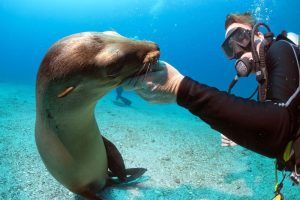
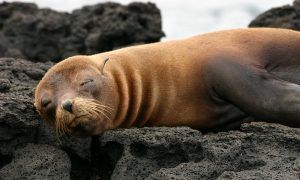
Galapagos fur seal (lat. Arctocephalus galapagoensis) is a species of eared seals from the subfamily of fur seals. Belongs to the genus of southern fur seals. You can spot them in the Galapagos national park.
Ask us for Galapagos islands boat tours.
Description
Galápagos fur seals are the smallest otariids. They are born with a black natal coat that they molt to reveal a lighter brown coat before becoming adults. Galápagos fur seals display sexual dimorphism. The males are up to 2x heavier than the females and 1–1.3 times longer. Males grow to be 1.5 m (5 feet) on average and weigh about 64 kg (140 lb). Females grow to be 1.25 m on average and weigh 27 kg (60 lb).
Spread & Lifestyle
The Galapagos Fur Seal is endemic to the Galapagos Islands. It does not migrate, spends all its life near the islands. It is classified as a non-migrant species. However, recent research has documented the presence of Galápagos fur seals in Mexico and Guatemala.
More than 70% of the time they spend on land. They feed mainly on numerous fish and cephalopods. Food is obtained at night, at the surface of the ocean, rarely they appear at a depth of more than 150 m.
Reproduction
Galápagos fur seals live in large colonies on the rocky beaches of the Galápagos Islands. These colonies are then divided into territories by the male seals during breeding season, which is mid-August to mid-November, with a peak in late September and early October. Each successful reproductive female will choose a territory on the beach to pup on.
Maternal care
Galápagos fur seals have the lowest reproductive rate reported in seals, and it takes an unusually long time to raise seal pups to independence. Females bear only one pup at a time, and she remains with her newborn for a week before leaving to feed. She then periodically returns to the pup and stays to suckle it for a few days before leaving on another hunting trip. Females recognize their own pups by smell and sound, and pups also learn to identify their mothers by the females’ “pup attraction calls”. Mother-pup recognition is crucial because females exclusively nurse their own pups, often violently rejecting strange pups that approach. Orphaned seal pups usually try to sneak up on sleeping or calling females to suckle, but stealing milk is not enough to sustain the pups, and they usually die within a month.
Where to See Galapagos Fur Seals
Galapagos fur seals can be spotted at several locations throughout the archipelago, particularly along rocky coastlines, in shaded crevices, and inside lava caves.
1. Puerto Egas — Santiago Island
One of the best places to observe Galapagos fur seals. They often rest in shaded caves and crevices along the rocky coastline.
2. Genovesa Island — Prince Philip’s Steps
Fur seals may be spotted resting among the volcanic rocks near the landing area.
3. Fernandina Island
Along with western Isabela, Fernandina is an important habitat for Galapagos fur seals, which can be found resting on rocky shores.
4. Rabida Island
Fur seals can occasionally be seen along the island’s rocky coastline, although sightings depend on local conditions.
5. Punta Vicente Roca — Isabela Island
Located on Isabela’s western coast, this area offers opportunities to spot fur seals among the rocky formations.
Best time to see them: Galapagos fur seals can be observed year-round, although sightings are never guaranteed.
Tip: Galapagos fur seals are different from Galapagos sea lions. Fur seals are generally smaller, have large eyes, and tend to prefer shaded rocky areas and caves, making them sometimes harder to spot.
Come to spend your holidays in the Galapagos islands! We’ll help you with getting to Galapagos.
Recommended tour for Seals